Last year I was a Guest of Honor at WisCon, a science fiction convention that’s historically been held in Madison, Wisconsin but last year was held as an online con. One of the things you do as a Guest of Honor at WisCon is you give a speech. I got asked right afterward to post it on my blog, and I kind of meant to but then forgot about it. However, I was thinking yesterday about how fundraising for people’s rent, one person at a time, feels a lot like flinging starfish back into the ocean in that classic story. There’s so much need, but it definitely matters to the person who now gets to stay housed for another month. I talked about that story in this speech, and after reading back over it I decided to post it. I am tweaking it slightly but mostly just by adding a couple of notes and links.
(I also told that story, and some of the other stories in this speech, at a DFL fundraiser where I was asked to speak last spring.)
Thank you so much for the invitation to be a Guest of Honor at WisCon. I have been regularly coming to WisCon since 1998 and this means a lot to me. Thank you to all the volunteers who helped to make this WisCon a reality. And thank you to Andrea for that moving, poetic, amazing speech.
Here’s something that most people know about writing: it usually takes a while to get published.
My earliest storytelling was not in written form but mostly was narration for play, like: let’s pretend we are characters from Star Wars and since there are not enough girls in those movies let’s also pretend that Han Solo has a younger sister. When I got to middle school, everyone else lost interest in these sorts of games. So I told stories to myself for a while, and then eventually started writing stories down. A lot of my middle school writing was for an audience of me. I was not trying to communicate with a reader, I was trying to play pretend on paper. This meant I could skip over anything I found boring and just write all the big climactic scenes with no buildup .
Sometime in high school, I started occasionally writing stories that had a beginning, middle, and end, and almost immediately after that, I started trying to get published. I dug out my manilla folder of ancient rejection letters while I was thinking about this speech, and the oldest one I found was from 1989, when I was 16 years old.
In college, I took one creative writing class, which was a short story writing class. We each wrote three stories and critiqued everyone else. It was a kind of mixed experience, like a lot of college creative writing classes. For example, there was a guy in the class who one time, instead of giving us critiques, gave everyone a slip of paper with some random noun like Hamster on it and then an explanation of how this was profound and postmodern and very deep. The downside of a Zoom speech is that I can’t tell if this is getting a laugh, but I’m going to assume that if we were all in a room together I would have gotten a laugh with a side of “oh yeah, THAT GUY, everyone who takes a creative writing class has some version of THAT GUY.”
Anyway, at the end of the class, one of the other students asked the professor whether he thought any of us had what it took to MAKE IT as a REAL WRITER. My recollection is that he sighed in a somewhat grudging way and then said, he had no way of knowing, because WHAT IT TOOK to MAKE IT was persistence. Not giving up. And he had no idea which of us would do that.
I remember thinking, “oh, well. If THAT’S all, I can do THAT.”
A few years ago I dug out the three ring binder where I saved all the stories from this class – as I’m writing this I’m thinking, between this binder and the folder of rejection letters from 1989 you’re all going to think I have a hoarding problem, and possibly you’re right – and looked up all the students I could find to see which of us had kept at it. The woman who wrote my favorite story that semester had a novel out. The woman who I think asked “which of us has what it takes” is now a professor of Jewish Studies, so she’s not writing fiction but she’s absolutely writing and she absolutely has a job where “not giving up” is required. The guy who handed out the Hamster critique had some name like John Johnson which makes him ungoogleable so alas I have no idea what he’s up to. [Side note: someone else in this class remembers a different person asking that question! Take my recollection of the details here with a grain of salt.]
Anyway. I submitted stories in high school, and got rejections. And I submitted stories in college, though not all that many, actually, because college kept me really busy, and they all got rejected. Two years after I graduated college, I joined a writer’s group, the Wyrdsmiths, which I’m still in, and I stepped up my story submissions, so I got a lot more rejections much more frequently.
Here’s the thing about writing that people do tell you but that’s hard to internalize until you’re doing it: sometimes, and especially when you’re getting started, it feels a little like screaming into a void.
I sold my first stories in 1999, so about ten years after I started submitting. This was actually pretty fast, as these things go.
I started selling stories in the print magazine era, which meant that I got both money and a copy of the magazine, which was cool, but not much in the way of feedback. I knew that probably people somewhere were reading it, because the magazine had thousands of subscribers, but at best, I might hear from a friend or family member.
I knew I had readers, in other words, but even once I started selling – it didn’t exactly feel like screaming into the void anymore but it maybe felt a little like throwing a rock into a pond in the dark. I could hear the faint splash but I kind of had to take it on trust that the ripples were there.
I sold my first novel in 2001, and it came out as two books in 2002 and 2003. And then I wrote a trilogy, which came out in 04, 05, and 06. The trilogy didn’t sell well and as you may recall, the economy tanked right after that, and I was unable to sell books for about a decade. Those five books are sufficiently forgotten that I pretty regularly run into people who think Catfishing on CatNet was my debut novel.
But in 2019 I went to WorldCon in Dublin, and a woman came to my reading with a battered copy of Fires of the Faithful. This book was creased, yellowed, and water-stained, and had clearly been re-read dozens and dozens of times. She wanted me to sign it for her and she told me that these books had gotten her through her teenage years.
So yeah, those ripples were out there.
I’d flung my words out and hoped they’d get to people who needed them, and sometimes they did. She was someone who got what she needed from something I wrote, and I got to hear about it, which was really cool.
The core true thing about fiction writing, I think, is that you have to believe that your words matter. That your voice matters. That what you write matters.
Because if you don’t believe those things, it is a lot easier to give up.
And here’s what I want you to take away from this speech today: your words matter. Your voice matters. Not everyone here is a writer, so I’m not talking about fiction, necessarily, I’m talking about all the other things you do, that we do. The things we build, the communities we connect, the people we lift up, all of it.
In February of 2020 I got back editorial revisions for my book Chaos on CatNet, which is set mostly in Minneapolis and Saint Paul. I live in St. Paul. What I normally do with revisions is to e-mail my editor and say “thank you, I will let you know if I have any questions,” read the editorial letter, and then set it aside for a bit. Because there’s nearly always something that makes me think “how dare!” and if I just let it sit for a bit instead of getting defensive, I start coming up with ways to fix everything, including the stuff that I was pretty sure initially didn’t need to be fixed. This is how my process works, it’s fine.
Anyway I got the edit letter on February 10th of 2020. I read it and set it aside and normally I would have been ready to start serious work on changes a few weeks later. But a few weeks later was when I sent an e-mail to my husband saying, “hey, so, I think we’re hitting the point where it would be prudent rather than paranoid to do a little judicious stocking up?” and instead of rolling his eyes he sent me a shopping list. As some people may recall, I actually wrote a story back in 2015 about someone cooking in a pandemic, and I pulled out that story and used it to make my list. I never used the egg replacer or the dry milk but I also never ran out of toilet paper.
And then I spent all of March waking up every morning and thinking, “holy shit, I am in the timeline with a pandemic” and adjusting to all the things that were suddenly, shockingly different in this new world we were all inhabiting, and the first half of April was similar, and at some point in late April I realized that I absolutely needed to work on my book, because I had a deadline.
So I sat down and made myself work on it and I was feeling pretty good about how the revisions were going, despite everything, as April wrapped up and May started.
And then, five years ago today, Memorial Day of 2020, a Minneapolis police officer murdered a Black man named George Floyd, setting off protests around the world but especially in Minneapolis and Saint Paul.
That murder is an event that has reverberated through the last five years in ways that I am absolutely not qualified to speak to, and I’m not going to try. As someone who lives in St. Paul, who lived in Minneapolis for 17 years prior to moving across the river, my experience of the aftermath was of something that was happening in, and to, both of my cities.
In that moment 5 years ago, my very specific personal corner was this: I was revising a book that was set in a future Minneapolis. The characters went on a bus ride down Lake Street; they visited Uncle Hugo’s science fiction bookstore. The third precinct police station was at the corner of Lake Street and Minnehaha Avenue and much of its immediate area was burned or badly damaged. Uncle Hugo’s burned to the ground. I wrote to my editor and said, “…I am going to miss my deadline.”
Because in addition to all the obvious reasons that I was struggling to even sit down and focus and write, just then: I had no idea how to even begin to imagine what Minneapolis would look like in the near future setting of the book.
Lyda Morehouse, who is my best friend – I met her through the Wyrdsmiths, the writer’s group I joined in 1997 – Lyda gave me the exact advice I needed, which was just, write the Minneapolis you want to see.
So once I had the mental space to write again, that’s what I tried to do. I wanted Uncle Hugo’s to rebuild, so I put a new Uncle Hugo’s right on Lake Street, with solar panels on the roof and a rocketship sculpture on the front. I put a public park named after George Floyd at the intersection of Lake and Minnehaha, where the Third Precinct police station had been partly burned down. And I imagined a future of policing with unarmed community safety officers, where my protagonist, wandering around outside on a dangerously cold night, encounters city safety workers who give her vouchers to buy a better coat and try to make sure she’ll be getting indoors promptly.
It’s been five years now, and did I get any of these things? Well, Uncle Hugo’s did re-open. It’s in a different spot than I put it in in my book, but I love the new location. The old Third Precinct building is still standing there and still wrecked. It’s going to be turned into a voter services center, probably next year. I am depressed about the situation with the Minneapolis police. I guess if I’m being optimistic I would say it remains a work in progress.
But here’s another thing I want you to take away from this speech: the future you imagine matters. Change is hard. It’s hard to demand and pursue and enact. And it helps a lot to have a vision of a destination. Somewhere we think we’re all headed.
I’m not saying that no one should write warning stories ever, the kind where you show people the dire consequences of building the torment nexus in the hopes that people will band together and at least refuse to buy an annual license for Torment Nexus (™) when it gets rolled out by some tech company in 2027. There’s absolutely a place for warning stories. For one thing, sometimes all we feel like we can do is stand in the middle of the public square, literally or metaphorically, and scream our warnings.
But I also think we need stories that offer a vision of something we can build at the end of the tunnel.
In 2004 I started blogging about local elections.
I started doing this because I’d figured out how to look up my ballot online before going to the polls, and had remembered to do this, and had set aside time to research all the random downticket races. I needed to take notes, and since I was doing the research online anyway, I opened up a Livejournal window and took my notes there. And then, since I had a few dozen LJ friends, at least two or three of whom lived in Minneapolis and might find it useful, I organized my notes, issued endorsements, and posted.
I framed my picks as endorsements, at that point, solely for my own entertainment. Because, you know, important people do endorsements, and I was literally an internet rando.
I did the same thing in 2005 and 2006. And then in 2007 I had no posts about the election, although possibly this was because there was no election in Minneapolis that year. But in 2008 my post about the election says, “by request,” because someone had asked me when I was going to post. That was when I started feeling a sense of obligation, because there were people out there who were using these posts. Like I had dozens of readers who were paying attention to my takes on local races!
So I kept writing them.
In Minneapolis and Saint Paul, this blog, way more than the science fiction writing, is what I’m known for. At this point, thousands of people read it, often looking it up from the voting booth on election day to figure out who to vote for in the races that don’t get news coverage.
It also means I’ve spent twenty years paying fairly close attention to local politics, and let me tell you, the local version of the Overton window has shifted.
And what changed things was that a different group of people started showing up. Young people, people of color, renters, bikers, transit users. People showed up to run, to campaign, to attend meetings and speak up.
And this all created a cultural shift, despite the fact that the urbanists and progressives lost a ton of battles.
Because showing up means you have to come and fight even though you lost the last time. And also even when you won the last time. You have to show up and you have to keep fighting even when it’s hard.
It is really hard right now.
It has been so hard since last November.
But people have continued coming together, and continued showing up. And continued pushing back and trying to keep vulnerable people safe and making it really clear that we are not going to lie down and accept fascism.
And we are not going to win every fight, but the more we push back the fewer fights we will lose.
There’s a classic kind of cliche story about a person who’s walking along a beach picking up stranded starfish and tossing them back into the ocean where someone asks what difference it makes, since they can’t get them all back in, and the person says, “it made a difference to this one.”
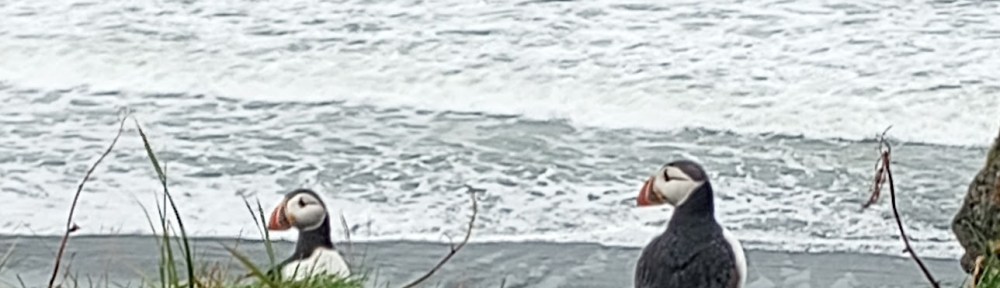
But OK. Here’s a real story, which was on NPR, about people who live in the Westman islands of Iceland. Puffins nest in Iceland, and when the babies are ready to fledge, historically they would find the ocean by following the light of the moon. Except in the modern era, cities produce enough light to confuse the baby puffins, which are called pufflings, and they wind up in town, stranded in nooks and crannies and unable to take off again. So during Puffling Season in the Westman Islands, the residents go out at night with flashlights, and boxes, and they gather up all the lost pufflings and take them out to the cliffs and toss them off the cliffs and towards the ocean where they need to go.
If it were one person out there rescuing puffins, it would still matter to each little puffin that person rescued.
But it’s not one person. It’s a whole community working together. And so they get most of the pufflings safely into the ocean where they spend a few years out at sea, fishing and swimming and bobbing around in the water, until they come back to that coastline to lay their own eggs.
Your words matter. Your voice matters.
Even when it feels like you’re shouting into the void, you are not.
You are throwing rocks into a dark pond, and you can trust that the ripples are there.
Or you are throwing starfish back into the ocean, and the ripples are there, and it mattered to that starfish.
Or you are throwing a baby puffin towards the ocean, creating ripples and keeping a bird population sustainable, because you are doing it with your whole community.
What you do matters.
What we do, matters.
 Will Tell Stories For Food
wonderful speech, Naomi!
And still so very pertinent, maybe even more so.
Theresa