
So as I mentioned: I spent the last couple of weeks in China. I went to Chongqing as the guest of the Fishing Fortress Science Fiction College of the Chongqing College of Mobile Communication in Hechuan. (Chongqing is both a city and a province — okay technically I think it’s a “direct-administered municipality” but I feel like “province” communicates what that means reasonably well. Hechuan is a “district” which in this case seems to basically mean “an outlying town.” It’s about an hour from the city of Chongqing.)
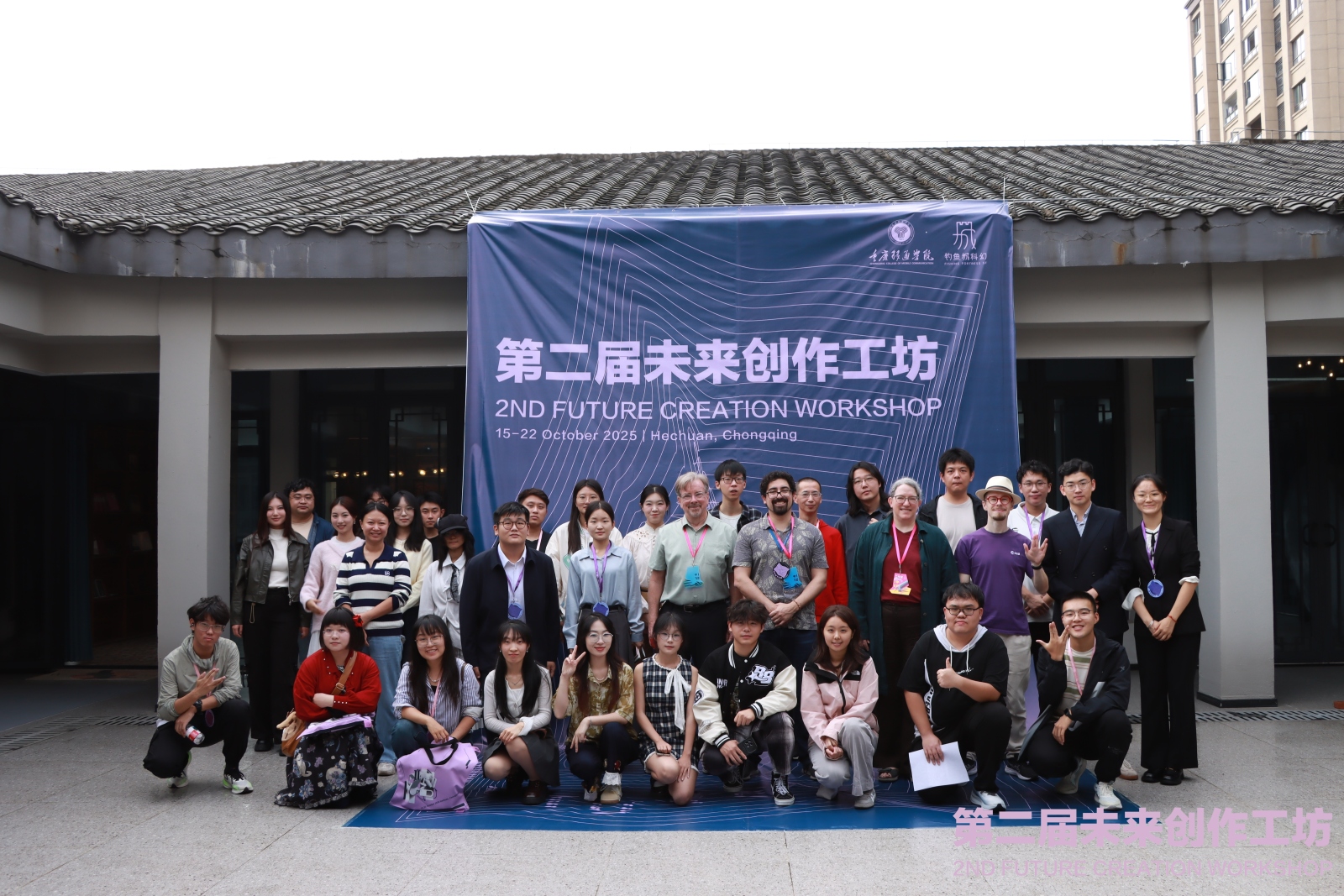
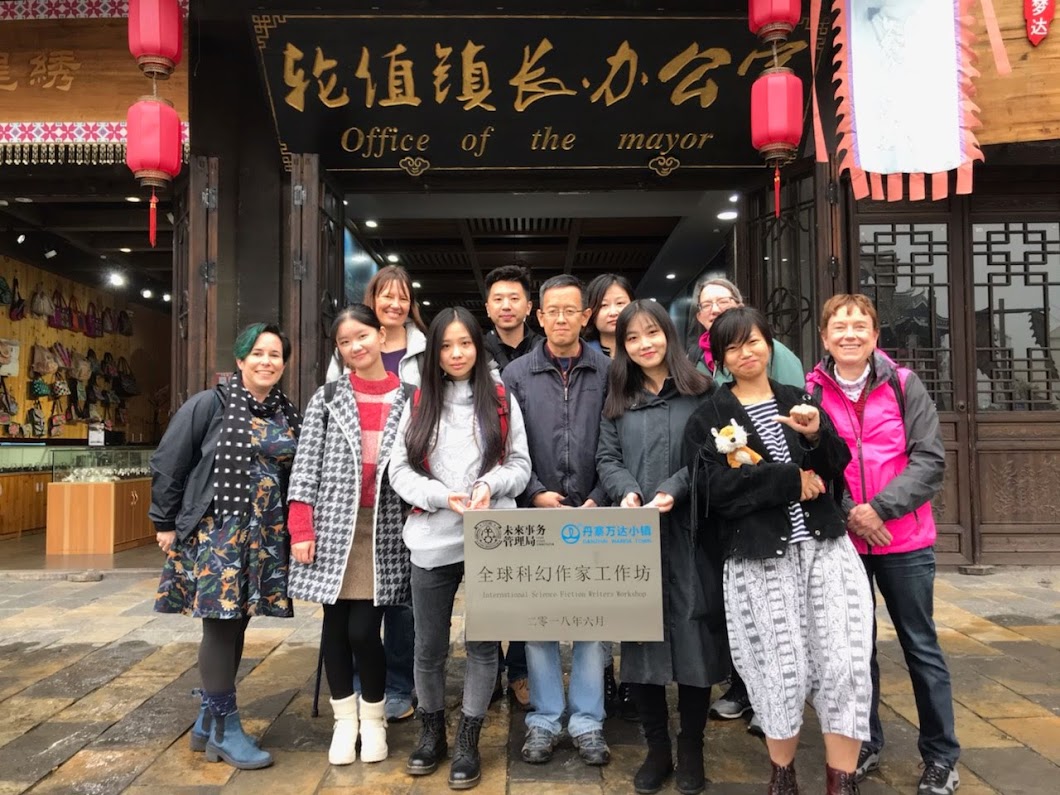
That’s a picture of (nearly) the whole workshop — teachers, students, staff, interpreters.
I had never taught at a workshop before, nor have I attended any of the big US workshops (Clarion, Clarion West, Odyssey, Viable Paradise, etc.) but I have participated in a writers’ group that does peer critique since 1997. The foreign instructors were all told to prepare two lectures — one two-hour lecture to be delivered just to the students in the workshop program, one 90-minute lecture to be delivered to anyone at the university who wanted to come. The 90-minute lecture was translated by our interpreter (which meant we needed to plan for less than 90 minutes) and the two-hour lecture was translated by speech recognition and machine translation.
For the “workshop” part, we each had two groups of three students. We worked with Group A for three days, and then with Group B for three days. Each student worked with two mentors, one Chinese and one foreign. The other foreign mentors were James Patrick Kelly, Roderick Leeuwenhart from the Netherlands, and Leonardo Epinoza Benavides from Chile. The Chinese mentors were Cheng Jingbo (who was introduced as Bo, at least to the English speakers), Ling Chen, Baoshu, Jiang Bo, and Deng Siyuan. (I think one of those people did lectures and not workshops but I’m not sure which.)
My students in Group A (I know I’m throwing a lot of names out here — this is partly for my own future reference! When I see a familiar looking name show up in Clarkesworld in 2028 I want to be able to come look at this) were Zhang HongRui (“Herry”), Xiong Qiong (“Shu”), and Gong Er (“Kiki”). My students in Group B were Cao Rong (“Ultraman”), Yang Luixi (“Osse”), and Nie Yong (“Andrew”). I had an interpreter all week, Li Min (“Diana”).
The program originally had all of us doing our workshops at tables in one big room, but the second day, Shu made a face and asked if there was anywhere quieter we could go. I sent Diana to find out, and she conferred with the program organizers and we relocated to this nice room with sofas, which was great.

(In the picture: Diana is the person whispering in my ear. Kiki is sitting to my left. Herry is in the brown t-shirt and Shu is in the black plaid shirt.)
Something I did not know before the first time I did something like this is that conversing through an interpreter is its own separate skill in a couple of ways. First, you need to pay close attention to what your interpreter is saying while filtering out the background noise of the person who’s speaking in the other language but hopefully still paying attention to their body language, tone of voice, etc. Like especially if you’re teaching, you want to notice if they’re getting frustrated or overwhelmed, and that’s especially important in a workshop setting where at least some of the students have not done peer critique before; one of my students did clearly start to feel overwhelmed and I temporarily stopped the critique and told him, this is still your story. We are not assigning you these changes. It is entirely up to you whether to make changes, or not; we are giving you our advice one what we think would make this a stronger story and you can take the advice that seems right to you and ignore everything else!

(From my first group, a photo of Shu and Herry.)
Second, when you’re speaking, you need to pause a lot more often so that your interpreter can tell people what you’re saying, and you need to do that without losing your train of thought. Third, sometimes interpreters don’t know a word and ideally you should have a relationship with them such that they’ll let you know and you can offer a synonym or rephrase.
All that said, the workshops seemed to work reasonably well. Some of my students spoke some English, which helped.
Here I am with my second group:
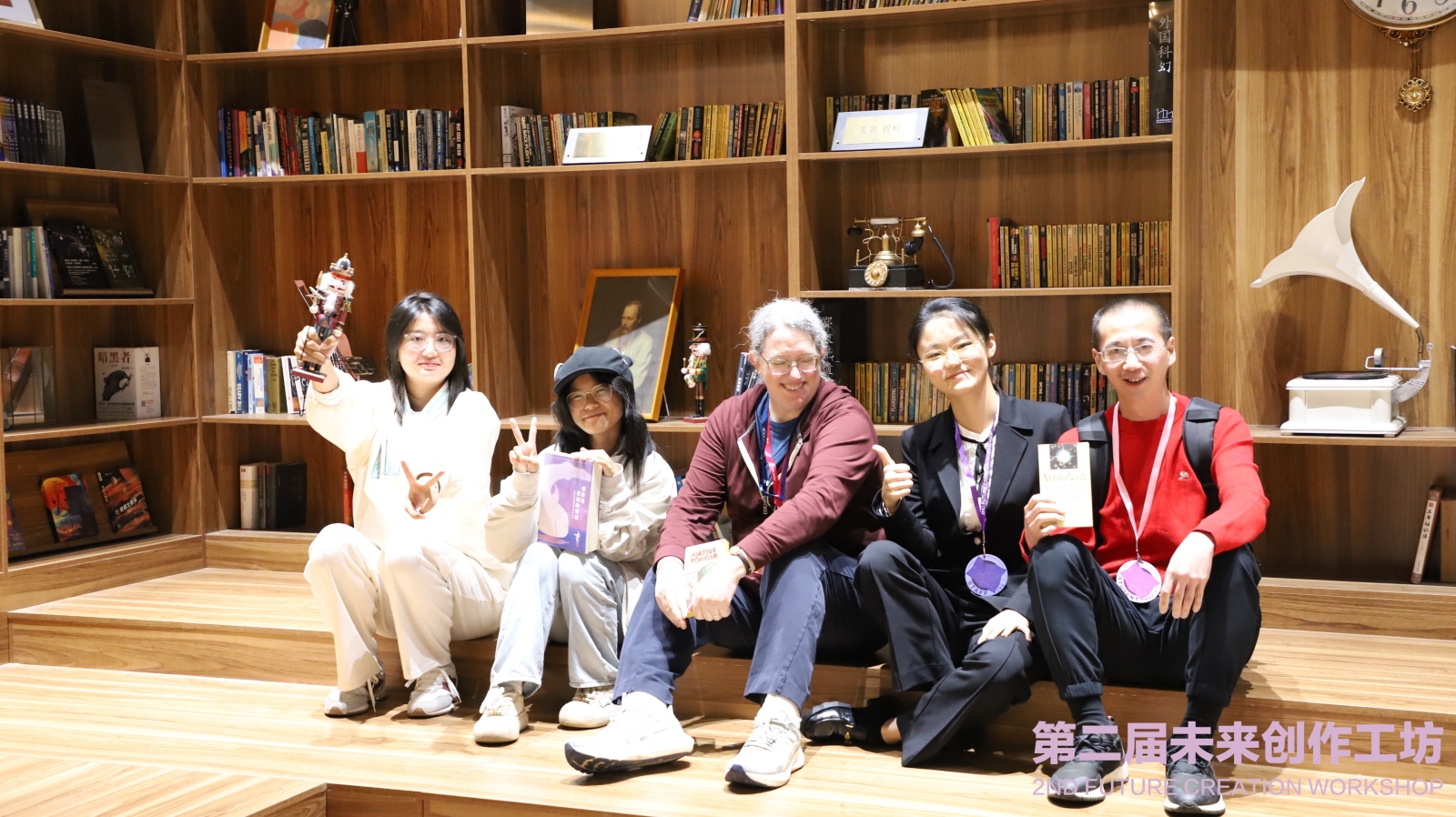
(This was a posed picture on the last day. Left to right: Ultraman, Osse, me, Diana, Andrew.)
We set a trend escaping the crowded room, which meant that as the week went by we kept having to find new spaces because other people would beat us to the couches. We stole some poor guy’s office several times:

As noted, I also had to deliver two talks. The first was on the very first day, when I did an evening talk to anyone in the college who wanted to come. I did a talk about good and bad advice I’d gotten on writing.
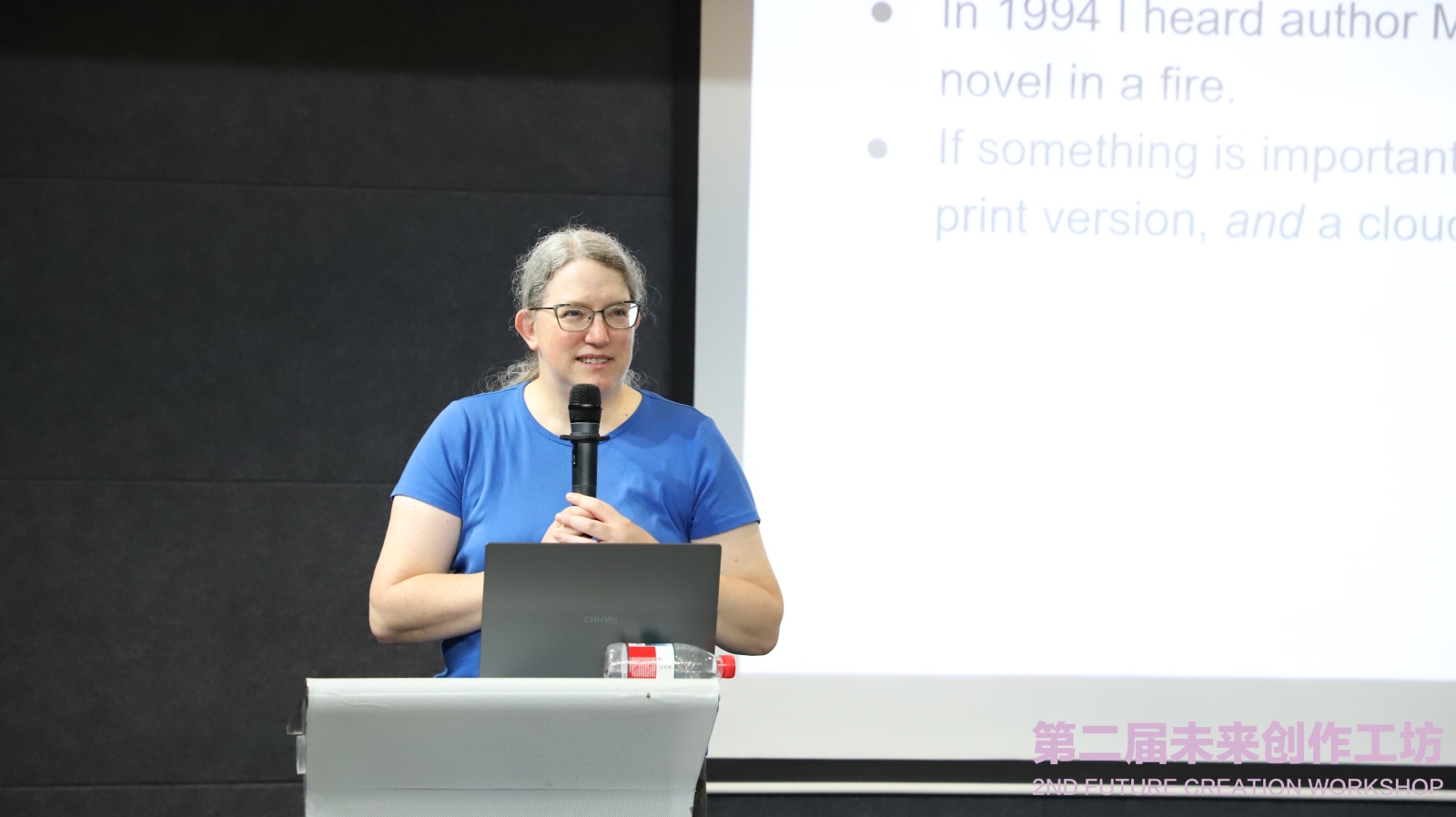
If you’re curious, the slide I’m in front of is about the advice to make backups and mentions that when I was in college, I heard author Maxine Hong Kingston give a talk where she read an absolutely harrowing story about trying to get to her house during the Oakland Firestorm of 1991 to rescue her manuscript. In The Fifth Book of Peace she tells this story and relates it in a metaphysical way to the Gulf War. I heard this story and thought, “this is a message from God to not only make backups but to figure out a way to do off site backups” which in the early 1990s was no joke — I used to burn CD-ROMs and then give them to my father to store at his house. These days it’s more critical to remember that you need not only the cloud backup but also the local copy in case you lose access to the cloud, a thing that can very much happen.
Did I mention my slides were basic and ugly? Just literally a bulleted list.
I had a nearly full house (I think this photo was taken that evening, they had me sit down in the audience at the end for a photo, which meant some poor person got booted out of their seat at that point!)

That talk was translated by Diana, who had looked at my slides in advance and done a ton of preparation. (I saw her notes, which were extensive.)
On the last day, I did my morning talk to the students in the program. Rather than trying to come up with two hours of material on one topic, I basically did two talks, one on the critical lessons I learned as a writer on my way to publication, and one on how I wrote my first novel. This was machine-translated by way of speech recognition. Including a somewhat unflattering photo of me because the image shows the translation in process:
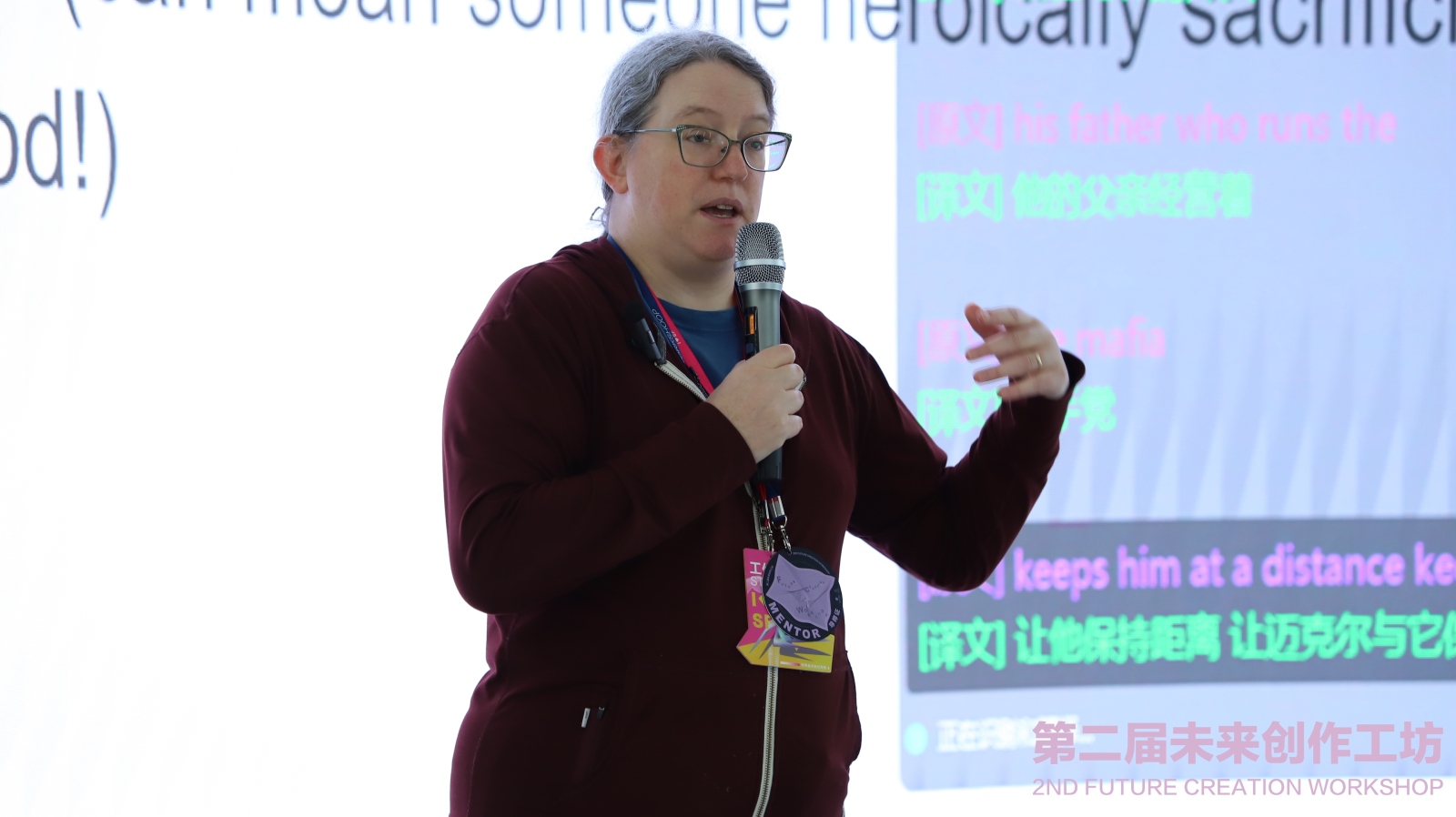
To be honest I had significant doubts about how well this would work, and I asked my students later if they were able to follow my talk. They said that it was helpful that I’d put an outline of the talk on very simple slides, because they could input the words on the slides into a translator app themselves and get some context for what I was saying. So, ugly slides for the win! Jim made it to more of the Chinese mentors’ talks than I did (this workshop had a heavy schedule and I skipped a bunch of other people’s talks because I needed to work on critiques for my students) and thought it worked pretty well.
Anyway: it was a really good experience, I enjoyed teaching, my students were great, the other mentors were great and I really enjoyed getting to know them, and I hope this workshop continues. I flew home over the weekend and have been slowly getting un-jet-lagged.


 Will Tell Stories For Food